in vivo Characterization of Rotenone-Induced Optic Neuropathy in a Mouse Model
Poster Authors:
Xiaohui Zhang, James Lee, Marcela Duran, Hannah Gill, Damara Villalobos, Sujata Rijal, Sudan Puri, Stephanie Peters, Yesica Chaparro, Vivian Trenti, Jenny Walters, Walter Collette, Manindra Singh, Matthew Lyulkin, Sara Mangosing Glenwood Gum, Sandeep Kumar
Ophthalmology, Pharmaron US Lab Services, San Diego, CA, United States.
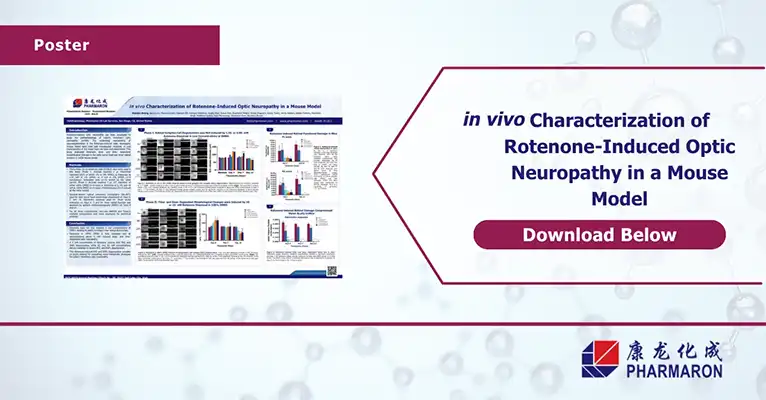
This study evaluates a mouse model of Leber’s Hereditary Optic Neuropathy (LHON) using intravitreal Rotenone to induce dose- and time-dependent optic nerve damage. While the model’s molecular mechanisms are known, its in vivo features had not been fully defined.?
Key highlights from our optic neuropathy poster:?
- Retinal changes: SD-OCT showed early GCC thickening (Day 4) followed by thinning (Day 14), indicating progression from inflammation to neurodegeneration.?
- Functional loss: High-dose Rotenone reduced PERG amplitudes at Day 4, suggesting early retinal dysfunction.?
- Therapeutic relevance: This model provides a rapid and quantifiable way to screen potential treatments for optic neuropathies like LHON.?
Our results confirm that SD-OCT and PERG are effective tools for monitoring retinal structure and function in vivo.