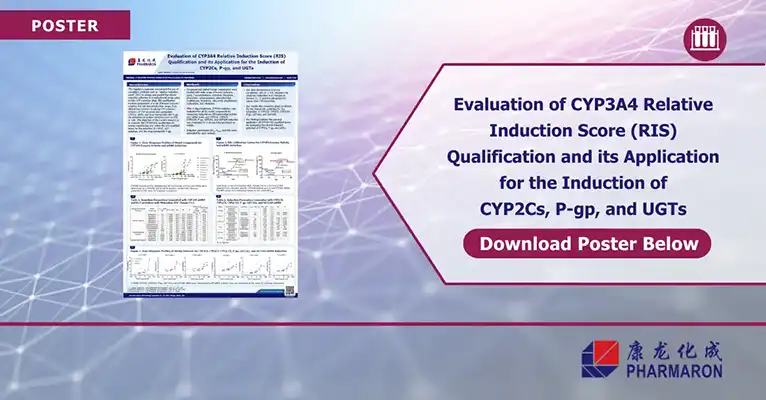
Evaluation of CYP3A4 Relative Induction Score (RIS) Qualification and its Application for the Induction of CYP2Cs, P-gp, and UGTs
Poster Authors:
Guru R. Valicherla, Ying Wang, Chris Bode, Sid Bhoopathy
Pharmaron (Exton) Lab Services LLC, Exton, PA, United States
Relative induction score (RIS) is gaining recognition as a vital in vitro method for predicting clinical drug-drug interactions (DDIs), especially for evaluating the induction potential of enzymes like CYP3A4, CYP2Cs, UGTs, and transporters such as P-gp. This summary explores how Pharmaron’s Exton laboratory is advancing RIS qualification to streamline DDI assessments with higher predictivity and regulatory acceptance.
What is the Relative Induction Score (RIS)?
The relative induction score is a quantitative framework that uses mRNA data from in vitro systems—typically human hepatocytes—to estimate a compound’s ability to induce drug-metabolizing enzymes. This metric helps predict midazolam AUC changes, which is a surrogate marker for CYP3A4 activity in vivo. Pharmaron’s approach validates RIS using rigorous mRNA induction parameters across several key metabolic pathways.
Expanded Application Beyond CYP3A4
Traditionally applied to CYP3A4, RIS is now being evaluated for its utility in predicting induction for:
- CYP2C8
- CYP2C9
- CYP2C19
- P-glycoprotein (P-gp)
- UGT1A1
- UGT1A4
The study presented at ISSX 2025 provides comparative induction parameters and expands RIS utility into previously unvalidated enzyme families. This supports broader application in early-phase drug metabolism and pharmacokinetics (DMPK) screening.
Why It Matters: Predictive Power in Drug Development
RIS correlates directly with observed clinical exposure changes, offering a reliable model for in vitro–in vivo extrapolation (IVIVE). For regulatory submission, it aligns with FDA and EMA expectations around quantitative DDI prediction tools. Its ability to model fold-change in AUC helps de-risk compounds early in the pipeline, reducing the chance of failure in later clinical stages.
Download the Full Poster to Learn More
Discover how Pharmaron is pushing RIS beyond traditional boundaries. The poster includes detailed RIS qualification data, mRNA fold-change tables, and correlation graphs mapping enzyme induction to systemic exposure changes.
References:
- J. George Zhang et al., Drug Metabolism and Disposition, 2014, 42, 1379-1397
- Odette A. Fahmi et al., Drug Metabolism and Disposition, 2008, 36 (9), 1971-1974
- Diane Ramsden et al., Drug Metabolism and Disposition, 2025, 53, 100052
Download the Brochure to explore the complete data and findings.