Stable Isotope Labeling by Amino Acid in Culture (SILAC) Approach for the Detection of Trapped Reactive Metabolites in Plated Hepatocytes
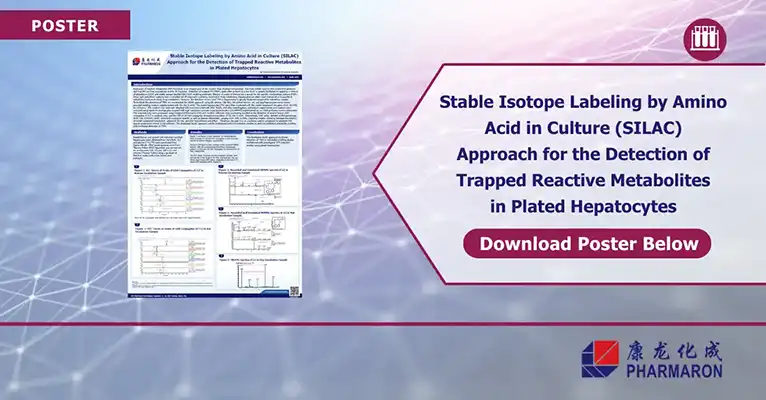
Poster Authors:
Igor Mezine, Guru Valicherla, Chris Bode, Sid Bhoopathy
Pharmaron, Exton, Pennsylvania, 19341, United States
Reactive metabolites (RMs) are unstable intermediates formed during drug metabolism that can covalently bind to cellular proteins, potentially leading to toxicity and adverse drug reactions. Evaluating RM formation is therefore a critical step in drug safety assessment and modern drug development workflows. Pharmaron’s latest research, presented at ISSX 2025, introduces a SILAC-based method that significantly improves the detection of trapped reactive metabolites in hepatocyte models.
Why Study Reactive Metabolites?
Detecting and characterizing reactive metabolites helps predict idiosyncratic drug toxicity and supports regulatory compliance for drug metabolism and pharmacokinetics (DMPK) submissions. Traditional in vitro systems such as liver microsomes and S9 fractions generate reactive intermediates, but they lack the full enzymatic machinery found in intact hepatocytes. This creates a sensitivity gap when studying low-level trapped reactive metabolites (TRM) in more physiologically relevant models.
The SILAC-Glycine Solution
Pharmaron researchers developed a Stable Isotope Labeling by Amino Acids in Culture (SILAC) approach, using SIL-glycine (SIL-Gly) supplementation in plated hepatocytes. When exposed to the model compound clozapine, hepatocytes incorporated SIL-Gly into glutathione (GSH), enabling:
- Automated monoisotopic pattern (MIP) recognition of GSH conjugates
- Higher specificity in detecting low-abundance TRM
- Species-dependent sensitivity profiling (human, rat, dog hepatocytes)
Notably, results showed conjugate-specific MIP ratios ranging from 20% to >100%, reflecting species differences in metabolism, uptake, and GSH biosynthesis.
Advantages of the SILAC Approach
- Improves RM detection sensitivity in hepatocyte-based assays
- Enables multiplexing with CYP induction studies for broader metabolite profiling
- Provides more accurate risk assessment for compounds prone to bioactivation
- Uses high-resolution LC-HRAMS with automated data analysis pipelines
This approach bridges the gap between traditional subcellular models and intact hepatocytes, making RM evaluation more predictive and scalable.
Conclusion and Call to Action
The SILAC-enabled method enhances the detection of reactive metabolites and supports integrated CYP induction and metabolite profiling studies. This innovative approach allows researchers to better understand compound bioactivation risks early in drug development.
References:
- S. Dragovic, P. Gunness, M, Ingelman-Sundberg, et al. Characterization of Human Cytochrome P450s Involved in the Bioactivation of Clozapine. Drug Metab Dispos. March 2013
- I. Mezine, C. Bode, S. Bhoopathy, et al. Simultaneous Metabolite Profiling and CYP Induction in Plated Cryopreserved Human Hepatocytes with Omeprazole as a Model Compound. AAPS Poster Presentation, 2018
Download the full ISSX 2025 poster to explore detailed spectral overlays, species comparisons and data workflows.