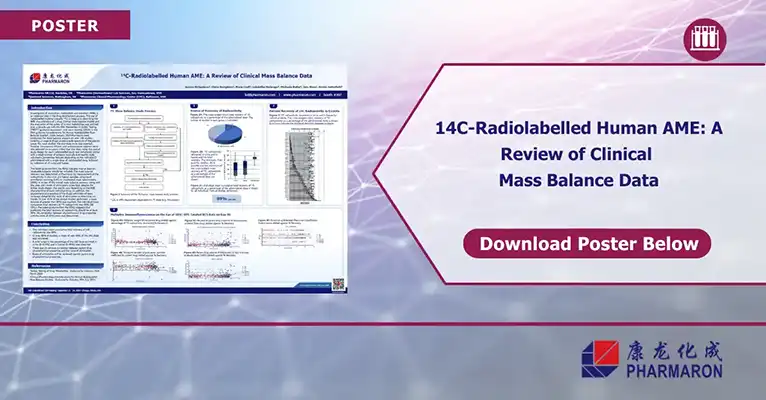
14C-Radiolabelled Human AME: A Review of Clinical Mass Balance Data
Poster Authors:
Jessica Richardson1, Claire Broughton1, Marie Croft2, Lakshitha Modarage1, Michaela Butler1, Iain Shaw3, Kristin Satterfield4
1Pharmaron UK Ltd, Rushden, UK
2Pharmaron (Germantown) Lab Services, Inc, Germantown, USA
3Quotient Sciences, Nottingham, UK
4Pharmaron Clinical Pharmacology Center (CPC), Baltimore, USA
Radiolabelled human AME supports smart program decisions. Radiolabelled human AME studies reveal how a new drug is absorbed, metabolized, and excreted so teams can defend dosing and label strategy. This page distills practical lessons from a large clinical data set and recent FDA guidance, then invites you to download the poster for full methods and figures.
Why Radiolabelled human AME is a must-have
Human radiolabeled mass balance work is expected for most NMEs. It clarifies total recovery, routes of elimination, and the need for follow-up metabolite safety work. FDA’s 2024 final guidance explains when to run the study, how to design it, and how to report it. It highlights design elements like subject count and recovery expectations so programs set the right bar early.
What a typical clinical mass balance study looks like
Most studies dose a single [1?C] batch to a small cohort, then collect urine and feces until recovery plateaus. Oral dosing is most common, with IV or SC used in select cases. Many programs enroll about 6 to 8 healthy adults, which matches the guidance that asks for at least six evaluable subjects. Radioactivity in excreta is measured by liquid scintillation counting or, at very low doses, by accelerated mass spectrometry
What the large data set tells you
Across more than 140 clinical studies analyzed with a common workflow, the cross-subject mean total recovery clustered near 89 percent. Over two in five studies reached at least 90 percent recovery. FDA notes that total recovery should preferably be at least 90 percent, which gives teams a clear target for protocol design and collection windows. No simple link was seen between common physicochemical properties and the favored route of elimination across drugs.
Design tips that raise your odds of clean recovery
Use a clear mass-balance process: dose calculation, controlled collection, residual checks on vessels, time-pooled excreta, feces homogenization with combustion, and LSC or AMS readout. Reserve AMS for microtracer-level work. Keep subjects in clinic until release criteria are met. The poster shows this process step-by-step so your team can map it to local SOPs.
What you’ll get when you download the poster
- Recovery distributions across studies and by matrix
- Side-by-side urine vs feces profiles by study
- Trends explored against multiple parent properties and clearance classes Practical notes on subject numbers, routes, and analytical choices
Reference:
- Safety Testing of Drug Metabolites. Guidance for Industry. FDA March 2020
- Clinical Pharmacology Considerations for Human Radiolabeled Mass Balance Studies. Guidance for Industry. FDA July 2024.
Download the poster now.