Assessing the Nuclease Resistance of Oligonucleotide Therapeutics in Lysosomes: An In Vitro Study
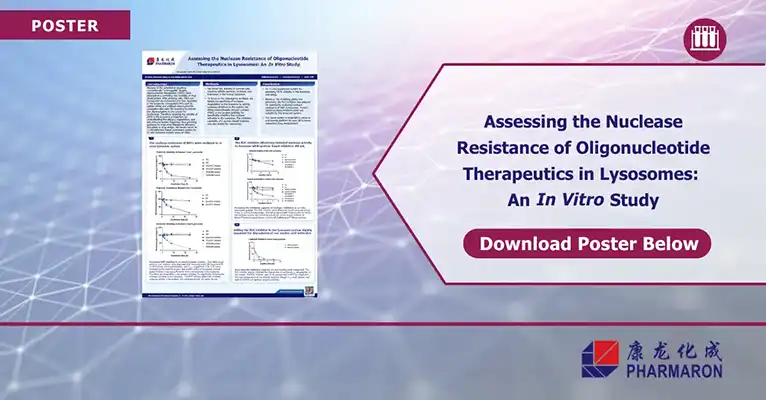
Poster Authors:
Sicong Zhang, Xuzhen Zhou, Chanyu Wang, Danxi Li, Mandy Xu
Pharmaron Beijing Co., Ltd., Beijing 100176, China
Oligonucleotide therapeutics are advancing fast, yet their journey through the cell is rough. This page summarizes a poster on how these drugs hold up inside human lysosomes and what that means for stability, delivery and safety. Read the insights, then download the poster to see the full data set and assay details.
Why lysosome stability matters for oligonucleotide therapeutics
Many ONTs enter cells by endocytosis, traffic through endosomes, then reach lysosomes where nucleases can cut them down. Some conjugates like GalNAc-siRNA and antibody-oligonucleotide conjugates even rely on lysosomal processing to release the active payload into the cytosol. Understanding lysosomal stability helps explain delivery, degradation and innate immune risk. It also guides safer, more efficient designs.
LC-MS in vitro assay built for oligonucleotide therapeutics
The team built an LC-MS detection system to quantify ONT stability in a human lysosome matrix. The method isolates nuclease-driven cleavage using targeted inhibition so developers can compare sequences, chemistries and conjugates in a controlled system.
Which nuclease inhibitors actually work in lysosome
Ribonucleoside vanadyl complex (RVC), a non-protein inhibitor, specifically blocked lysosomal nuclease activity in the assay. Two common protein inhibitors did not perform in this environment, likely due to the strong protein degradation capacity of lysosomes. The platform therefore uses RVC for selective readouts of nuclease resistance.
What happened to approved siRNA drugs
Commercial siRNA drugs patisiran and inclisiran degraded in human lysosome to 6.76–11.92% of starting concentration within 24 hours. The half-life ranged from 3.25–7.78 hours across strands. These readouts give practical kinetics for benchmarking new designs.
Any effect on non-nucleic molecules
Adding RVC slightly reduced degradation of carfizomib, a tetrapeptide. Because RVC must be pre-warmed to 65 °C for dissolution, a small heat carryover may blunt general enzyme activity. This helps set assay controls and interpretation windows.
What this means for oligonucleotide therapeutics R&D
- Use lysosome-relevant assays when screening leads since many ONTs pass through this compartment.
- Prefer non-protein nuclease inhibition in lysosomal matrices. RVC enables selective nuclease readouts where protein inhibitors fail.
- Compare half-life and percent remaining at 24 hours to rank candidates and chemistries.
Download the poster
Get the experimental setup, reagent details, LC-MS parameters and full data for patisiran, inclisiran and tivanisiran.
Download the poster to speed up screening workflows and make better decisions sooner.