Drug Metabolism and IVIVE: Comparing Microsomes and Hepatocytes for Metabolic Stability Screening
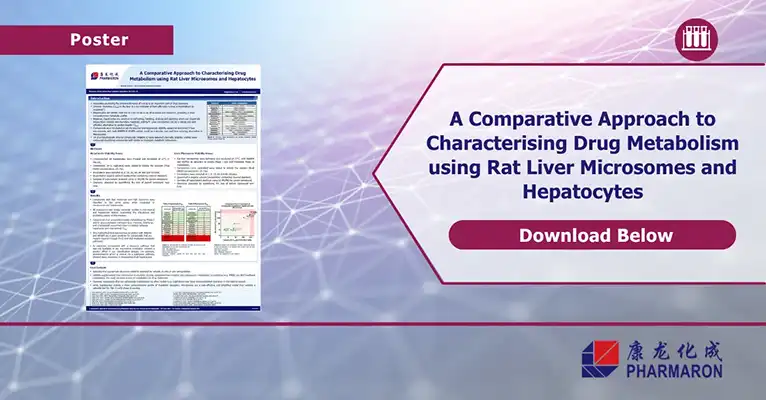
Poster Authors:
Sherifah Dawodu, Laura Tomlinson and Katherine Fenner
Pharmaron UK Ltd, Hertford Road Hoddesdon Hertfordshire, EN11 9FH, UK
Overview of Metabolic Stability in Drug Discovery
In early-phase drug development, understanding a compound’s metabolic stability is crucial for predicting its behavior in the body. This includes assessing intrinsic clearance (CLint), a key metric of how rapidly liver enzymes break down drug molecules. The two most common in vitro models—rat liver microsomes and hepatocytes—offer complementary approaches to studying drug metabolism. This poster compares both models to support better in vitro-in vivo extrapolation (IVIVE) and inform compound selection during early discovery screening.
Hepatocytes vs Microsomes: Tools for Predicting Drug Metabolism
Why Choose Hepatocytes?
- Full enzymatic capability: Include Phase I and Phase II enzymes with cofactors.
- More physiological model: Simulate whole-cell metabolism.
- Challenges: Sensitive to freezing, pipetting, and incubation conditions, which can affect data reliability.
Why Use Microsomes?
- Robust and cost-effective: Easy to prepare and standardize.
- Enable targeted metabolism studies: Especially effective for Phase I (e.g., P450) and glucuronidation pathways when supplemented with NADPH and UDPGA.
- Limitation: Do not reflect metabolism via non-available pathways like sulphation.
Experimental Design and Key Findings
Researchers at Pharmaron UK incubated 14 structurally diverse compounds in rat liver microsome and hepatocyte assays. Both models measured CLint via LC-MS/MS, analyzing the loss of parent compound over time.
Consistent Classification
- Compounds with high, moderate, or low clearance typically fell into the same group across both systems.
- High correlation was observed for compounds metabolized via P450 and UGT pathways (e.g., imatinib, diclofenac, propranolol).
Notable Exceptions
- Compounds metabolized through sulphation (e.g., acetaminophen) showed underestimation in microsomes due to the absence of enzymatic pathways.
Implications for IVIVE and Drug Development
The results support the use of microsomes as a valid first-line model for predicting drug metabolism, particularly to characterize molecules that are metabolized via the most common routes of drug metabolism. While hepatocytes remain the gold standard for complete metabolic profiling, microsomes are ideal for Tier-1 high-throughput screening, saving time and cost.
Download the Full Comparative Study Poster
Learn how your preclinical development programs can benefit from a dual-model strategy. The poster provides detailed data, visual comparisons of clearance, and best practices for selecting between microsomes and hepatocytes.
References: