14C-Radiolabeled Human AME: How Does Modern Accelerator Mass Spectrometry Enable The Human Ame Study
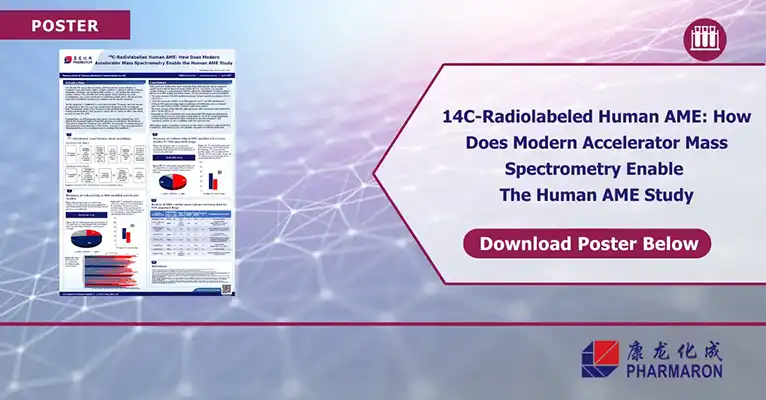
Poster Authors:
Marie Croft1;Stephen English2; Mitesh Sanghvi2
2Pharmaron (Germantown) Laboratory Services, Inc., USA
Human radiolabeled mass balance studies are essential to show where a dose goes and how it leaves the body. When conventional liquid scintillation counting (LSC) can’t see low levels, accelerator mass spectrometry (AMS) enables ultra-sensitive 14C detection—supporting credible recovery assessments at therapeutic or microtracer doses. In our longitudinal dataset (2013–2024; 55 compounds), mean recovery was 85.2% (SD 13.3), driven by compound-specific factors—not AMS limitations.
Why AMS for human radiolabeled mass balance?
- Detects microtracer (~1 μCi) and intermediate (≈50–100 μCi) 14C doses beyond LSC sensitivity.
- Supports first-in-human designs and patient studies when total radioactivity is low or elimination is prolonged
- Maintains analytical rigor comparable to traditional methods while widening feasible study designs.
Regulatory context (what “good” looks like):
FDA guidance prefers >90% total recovery in urine + feces and expects a scientific rationale when recovery is lower (e.g., covalent binding, long half-life, incomplete sample collection). Our analysis confirms that sub-90% recovery in AMS-enabled studies typically reflects drug biology—not a sensitivity gap.
What the data show (quick benchmarks):
- 55 AMS-enabled studies (2013–2024): mean recovery 85.2% (SD 13.3).
- FDA-approved subset (8 drugs): mean recovery ~78–79%; lower recoveries were explained by covalent binding, long plasma total 14C half-life, or incomplete collection.
- Implication: AMS unlocks viable human radiolabeled mass balance when conventional designs struggle, while still producing decision-grade DMPK evidence.
How Pharmaron runs AMS mass balance:
- Flexible collection workflows (daily ship or end-period batch) with in-clinic discharge criteria and return visits as needed.
- LSC first where feasible; switch to AMS when LSC approaches its LLOQ—maximizing sensitivity and efficiency.
References:
- Young. G.C. et al. Considerations for Human ADME strategy and Design Paradigm Shift(s) – An Industry White Paper. Clin Pharmacol Ther, 2023 Apr; 113(4):775-781.
- Clinical Pharmacology Considerations for Human Radiolabeled Mass Balance Studies. Guidance for Industry. FDA July 2024.
- Roffey et. Al. What is the objective of the mass balance study? A retrospective analysis of data in animal and human excretion studies employing radiolabeled drugs. Drug Metab Rev. 2007;39(1):17-43
- A phase I study to investigate the absorption, pharmacokinetics, and excretion of [14C]Prucalopride after a single oral dose in healthy volunteers. Clin Ther. 2016 Sep;38(9):2106-15
- Human mass balance study of TAS-102 using 14C analyzed by accelerator mass spectrometry. Cancer Chemother Pharmacol, 2016 Mar; 77(3)515-526.
- Metabolic disposition of Osimertinib in rats, dogs, and humans: Insights into a drug designed to bind covalently to a cysteine residue of epidermal growth factor receptor. Drug Metab Dispos. 2016 Aug;44(8):1201-12
- Huynh et a., Absorption, Metabolism, and Excretion of ACT-1004-1239, a First-In-Class CXCR7 Antagonist: In Vitro, Preclinical, and Clinical Data. Front Pharmacol. 2022 Mar 30;13:812065
- Vuu et. al, Absorption, metabolism and excretion of [14C]-sotorasib in healthy male subjects: characterization of metabolites and a minor albumin-sotorasib conjugate, Cancer Chemother and Pharmacol. 2022 90(9):357-367
- Rahbaek et. al, Absorption, single-dose and steady-state metabolism, excretion and pharmacokinetics of adagrasib, a KRASG12C inhibitor, Cancer Chemother Pharmacol. 2025 95(7)
- Pharmacokinetics, biotransformation, and excretion of [14C]-Etelcalcetide (AMG 416) following a single microtracer intravenous dose in patients with chronic kidney disease on hemodialysis. Clin Pharmacokinet. 2017 Feb;56(2):179-192
Download the full poster.