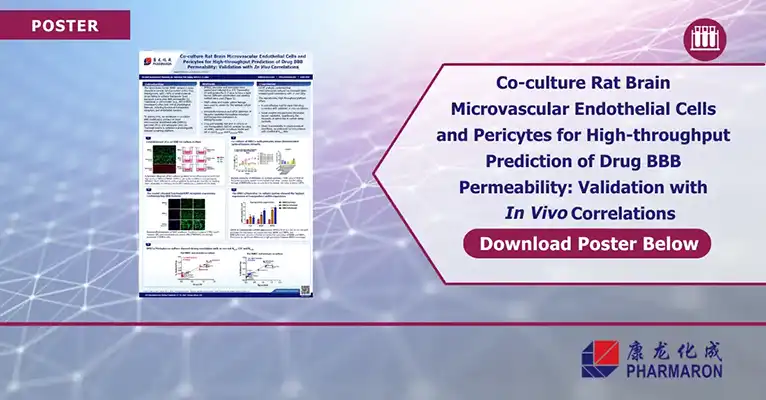
Co-culture Rat Brain Microvascular Endothelial Cells and Pericytes for High-throughput Prediction of Drug BBB Permeability: Validation with In Vivo Correlations
Poster Authors:
Jing Lai; Huimin Chen; Qi Cheng; Danxi Li; Mandy Xu
Pharmaron, 6#, Taihe Road, BDA, Beijing, 100176, P. R. China
Drug BBB permeability drives CNS success. This summary explains a primary rat co-culture model that predicts brain exposure and aligns with in vivo Kp,uu data. Download the poster to see methods, markers, and correlation plots that guide early screening.
Why measure drug BBB permeability
The blood brain barrier blocks most small molecules. More than 98% of candidates fail to reach useful brain levels due to poor permeability, so early screens must reflect real barrier biology. Traditional monolayers like MDCK-MDR1 miss key transporters and receptors, which leads to false signals.
A validated co-culture that matches in vivo
Scientists built a Transwell system with primary rat brain microvascular endothelial cells, pericytes, and astrocytes. They seeded cells in different layouts and used TEER and lucifer yellow leakage to rank barrier tightness. Co-culture of BMECs with pericytes gave the best integrity with the highest TEER and the lowest leakage at about 2.07%.
BBB markers that matter
The model kept receptor mediated transcytosis features. BMECs strongly expressed transferrin receptor, insulin receptor, and TMEM30A by immunofluorescence. Transporter mRNA profiling showed P-gp, BCRP, and MRP4 induction on Transwells. Adding pericytes further increased BCRP and MRP4 while P-gp did not change much, which supports realistic efflux control.
IVIVE supports decision making
Drug permeability testing in the BMEC-pericyte co-culture correlated with rat in vivo unbound partitioning metrics Kp,uu,CSF and Kp,uu,brain. The platform is reproducible and high-throughput, which makes it a cost-effective screen that translates into preclinical workflows. Results also suggest barrier regulation is dominated by pericytes, so astrocytes may not be required in some assay contexts.
What this means for drug blood brain barrier permeability programs
Use co-culture with pericytes for primary screens since it preserves RMT targets and efflux transporters. Combine TEER, lucifer yellow, and qPCR panels to standardize tightness and mechanism. Map in vitro ranks to Kp,uu so teams can triage chemotypes and delivery strategies earlier in lead optimization.
References:
Download the Poster
Download the poster to review cell sources, seeding methods, marker panels, and IVIVE correlations so you can benchmark your own BBB model with confidence.