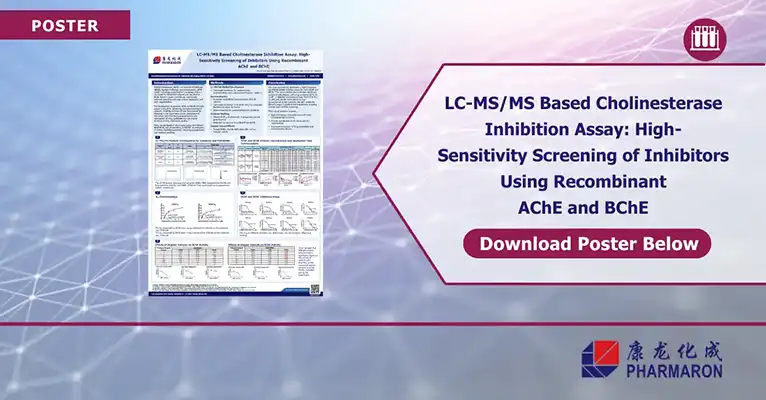
LC-MS/MS Based Cholinesterase Inhibition Assay: High-Sensitivity Screening of Inhibitors Using Recombinant AChE and BChE
Poster Authors:
Jing Lai; Gang Yang; Yushi Cao; Xuehua Zhang; Yi Li; Youpeng Yang; Chunyan Han; Mandy Xu
Pharmaron, 6#, Taihe Road, BDA, Beijing, 100176, P. R. China
Cholinesterase inhibition assay information helps teams find weak and strong inhibitors with confidence. This poster explains the science behind AChE and BChE testing, why LC-MS/MS boosts sensitivity, and how to design a clean screen.
Why a cholinesterase inhibition assay matters
Acetylcholinesterase and butyrylcholinesterase control cholinergic tone in the brain and periphery. They link to Alzheimer’s research, myasthenia gravis, drug metabolism, and toxin defense. A reliable assay supports SAR work, risk assessment, and lead optimization from hit to candidate.
What sets LC-MS/MS apart
This platform quantifies choline, the enzymatic product, by LC-MS/MS which lifts sensitivity and avoids chromogenic side effects seen in Ellman’s tests. The method reached a choline LLOQ near 2 nM which is far lower than DIOS-TOF MS and lower than many conventional LC-MS runs. That lets you detect partial inhibition and rank modest binders without guesswork.
Assay design you can trust
- Recombinant enzymes. Use purified human AChE and BChE so substrate use reflects enzyme kinetics not cell background. Screen enzyme levels across low ng/mL and tune incubation time from minutes to an hour to stay in the linear range.
- Kinetic anchors. Determine Km with the matched substrate then set working concentrations around that value to balance signal and sensitivity. Example Km values for AChE with acetylcholine and BChE with butyrylcholine guide setup.
- Reference inhibitors. Build confidence with donepezil, rivastigmine, tacrine, and galantamine to confirm your IC50 workflow and curve fitting.
- Solvent control. Keep DMSO, methanol, and acetonitrile very low since each can reduce enzyme activity. Run a quick solvent panel before screening to lock settings.
- Instrumentation. Triple quadrupole LC-MS systems support robust multiplexing for substrate and product which helps with throughput and QC.
How this helps discovery teams
LC-MS/MS readouts reduce interferences and tighten LLOQ so you can see weak inhibition early. That shortens iteration cycles for scaffold hops and helps flag off-target cholinesterase effects in non-CNS programs. The same setup supports toxin or metabolite studies where low-level activity shifts matter.
References:
- Soreq H, Seidman S. Acetylcholinesterase–new roles for an old actor. Nature Reviews Neuroscience, 2001, 2(4):294-302.
- Darvesh S, Hopkins D A, Geula C. Neurobiology of butyrylcholinesterase. Nature Reviews Neuroscience, 2003, 4(2):131-138.
- Lockridge O. Review of human butyrylcholinesterase structure, function, genetic variants, history of use in the clinic, and potential therapeutic uses. Pharmacology & Therapeutics, 2015, 148:34-46.
- Mackness M, Mackness B. Human paraoxonase-1 (PON1): Gene structure and expression, promiscuous activities and multiple physiological roles. Gene, 2015, 567(1):12-21.
- Lamy E ,Léa Pilyser, Paquet C ,et al.High-sensitivity quantification of acetylcholine and choline in human cerebrospinal fluid with a validated LC-MS/MS method. Talanta, 2020, 224(5170):121881.
Download the poster.