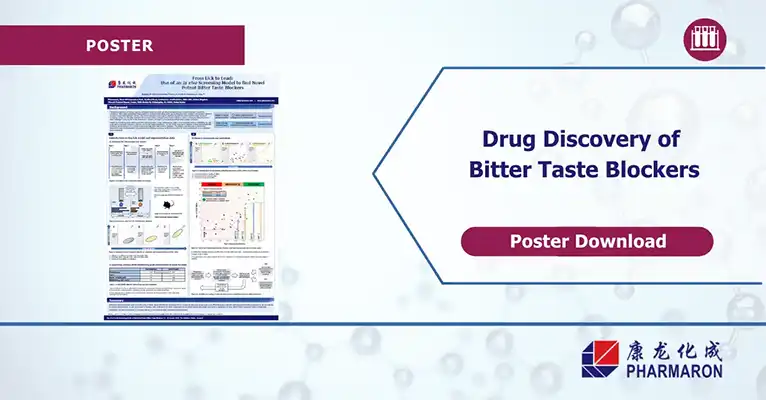
From Lick to Lead: Use of an in vivo Screening Model to Find Novel Potent Bitter Taste Blockers
Poster Authors:
Michael Bestwick1, Gillian Watt1, Fran?ois Saint-Dizier1, Amy Brown1, Kevin Foote1, Sebastien Campos1, Jennifer Borthwick1, O. Smith1, Verity Kennett1, John Pollard1, John Maclean1, R. Twidale1, M. Tordoff2, Carol Christensen2, Peihua Jiang2
1Pharmaron, West Hill Innovation Park, Hertford Road, Hoddesdon, Hertfordshire, EN11 9FH, United Kingdom
2Monell Chemical Senses Center, 3500 Market St, Philadelphia, PA 19104, United States
PK/PD relationships, in vivo Evaluation, and Integrated Drug Discovery of Bitter Taste Blockers
This poster was presented at the ELRIG Drug Discovery 2025.
The taste of medication is a critical factor in patient compliance, particularly for pediatric and geriatric populations. Bitter-tasting active pharmaceutical ingredients can significantly hinder adherence, thereby compromising treatment outcomes. To address this challenge, Pharmaron’s drug discovery services team worked with the Monell Chemical Senses Center to undertake an unconventional drug discovery project targeting bitter taste modulation.
Approach to Bitter Blocker Drug Discovery
To facilitate the discovery of bitter blockers, an integrated team from Pharmaron, the Monell Chemical Senses Center, and the Gates Foundation was assembled. An existing in vivo mouse model for bitter taste was optimized for drug discovery purposes, and PK/PD relationships were determined, enabling the model to be used for ranking and screening novel compounds.
Optimizing for Potency and ADME Properties
Lead optimization began with a tool compound and achieved improved potency (pIC50 8.1) compared to the initial compound (pIC50 7.3), while maintaining similar lipophilicity (Log D) and improving kinetic solubility. Optimization focused on key absorption properties relevant to the oral cavity, such as permeability and solubility.
Predictive Modeling for Efficient Screening
A predictive regression model was developed to correlate compound potency and concentration with observed in vivo efficacy. This model enabled more efficient lead selection and supported the development of optimized dosing strategies for future studies.
Download our poster to view our case study on the discovery of a novel bitter blocker performed in cooperation with the Monell Chemical Senses Center.