Adeno-Associated Virus (AAV) Production: A Collaborative Approach to Accelerate Process Optimisation
Poster Authors:
Christopher Boyd, Helene Trottin, Spyridon Gerontas
Pharmaron Gene Therapy | Estuary Commerce Park, Speke, Liverpool, L24 8RB, UK
Collaborative Process Optimization for Adeno-Associated Virus Production
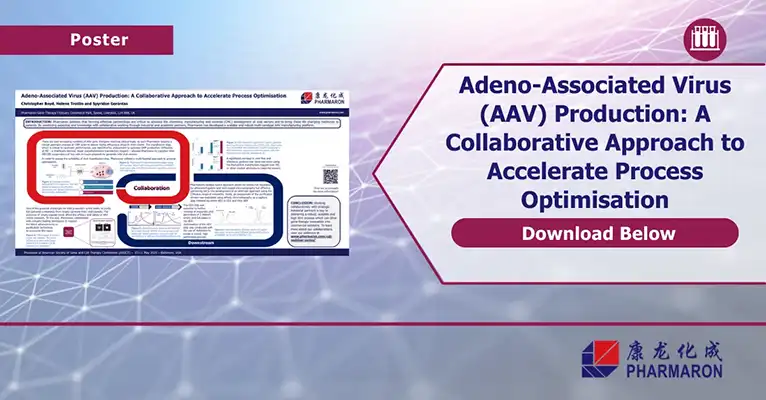
As more gene therapies move into the clinic, adeno-associated virus manufacturing has to scale without losing performance. In this work, Pharmaron focused on the upstream step that often sets the ceiling for yield: transient transfection. A chemically defined, linear PEI transfection reagent was used to transfect a suspension HEK293 platform with in-house plasmids to produce AAV vectors, then the transfection workflow was stress-tested and optimized using a multi-pronged approach that combines automated high-throughput process development (HTPD), Design of Experiments (DoE), and statistical analysis.
The optimization effort was designed to move fast and stay GMP-relevant: compare transfection conditions and reagents, quantify gains in capsid and infectious titre, and then connect upstream improvements to downstream realities. On the purification side, Pharmaron applied a toolbox strategy to tackle one of the toughest quality problems in adeno-associated virus production—separating full (genome-containing) from empty capsids—using combinations of affinity capture, anion/cation exchange chromatography, and process stabilizers to drive cleaner separation and more robust performance.